


You are trading the exchange rate between two currencies, not physical money.
You are speculating on whether one currency will become stronger or weaker compared to another.
Your profit or loss comes from price movement, not from owning or exchanging foreign cash.
That’s it. Everything else in Forex builds on this idea.
Table of Contents
- Forex Is Trading Currency Value, Not Money Itself
- Currencies Are Always Traded in Pairs – Here’s Why
- What Is a Forex Currency Pair?
- Base Currency and Quote Currency Explained Simply
- You Are Trading Exchange Rates, Not Physical Currencies
- What Retail Forex Traders Actually Trade
- Spot Forex vs CFDs – What’s the Difference for Retail Traders?
- Why Retail Traders Don’t Trade in the Interbank Market
- What You’re Really Speculating on in Forex
Forex Is Currency Value, Not Money Itself
Forex trading is about speculating on changes in currency value, not owning or moving physical cash.
When you trade Forex, you are:
- Not receiving banknotes
- Not storing foreign currency
- Not transferring money overseas
Instead, you are making a price-based trade on how one currency’s value changes relative to another currency.
Think of Forex as trading relationships between currencies, not the currencies themselves.
Currencies Are Always Traded in Pairs – Here’s Why
A currency by itself has no standalone price.
A euro has value only when compared to:
- the US dollar
- the Japanese yen
- the British pound
…and so on.
That’s why Forex prices are always quoted in pairs.
You are never asking:
“What is the price of the euro?”
You are always asking:
“What is the price of the euro compared to something else?”
What is a Forex Currency Pair?
A currency pair is the foundation of every Forex trade.
Examples:
- EUR/USD
- USD/JPY
- GBP/USD
Each pair represents:
The value of one currency relative to another currency
For example:
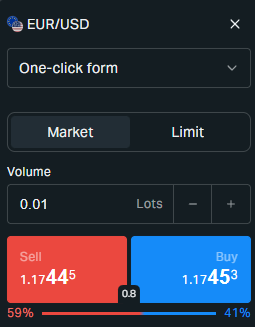
- EUR/USD = 1.1745
This means 1 euro is worth 1.1745 US dollars.
You are not trading euros or dollars individually—you are trading the exchange rate between them.
Base Currency and Quote Currency Explained Simply
Every currency pair has two parts:
Base Currency
- The first currency in the pair
- Represents the currency being measured
Quote Currency
- The second currency in the pair
- Represents what the base currency is being compared to
Example: EUR/USD
- Base currency: EUR
- Quote currency: USD
If EUR/USD goes up, it means:
The euro is getting stronger compared to the US dollar
You Are Trading Exchange Rates, Not Physical Currencies
This is a key concept:
Forex traders trade exchange rate movements.
You are speculating on:
- Will this exchange rate go up?
- Or will it go down?
Profit and loss come from:
- Price differences
- Not currency ownership
That’s why Forex trading works more like financial speculation than traditional currency exchange.
What Retail Forex Traders Actually Trade
Retail traders (individual traders like you and me) do not trade in the global interbank market.
Instead, retail traders trade:
- Price contracts
- Based on real exchange rates
- Provided by brokers
These trades are usually done through margin-based instruments, not physical settlement.
Spot Forex vs CFDs – What’s the Difference for Retail Traders?
In the institutional world, banks trade spot Forex, where currencies are actually exchanged between accounts.
Retail traders, however, usually trade Forex CFDs (Contracts for Difference).
With CFDs:
- You don’t own the currency
- You don’t receive delivery
- You only profit or lose based on price movement
This makes Forex accessible to small traders with limited capital.
Why Retail Traders Don’t Trade in the Interbank Market
The real Forex market is:
- Decentralized
- Traded between banks, institutions, and governments
- Requires massive capital and credit lines
Retail traders can’t access this directly.
That’s why brokers exist—to:
- Stream prices from liquidity providers
- Offer smaller contract sizes
- Allow leveraged trading
What You’re Really Speculating on in Forex
At its core, Forex trading is about predicting:
- Economic strength
- Interest rate differences
- Capital flows
- Market sentiment
You are not trading money.
You are trading expectations about currency value.
Final Takeaway
So, what are you actually trading in Forex?
✔ Not physical money
✔ Not foreign cash exchange
✔ Not banknotes or coins
👉 You are trading exchange rate movements between currency pairs, usually through CFDs, by speculating on whether one currency will strengthen or weaken relative to another.
Understanding this clearly is the foundation for everything else in Forex trading.

