

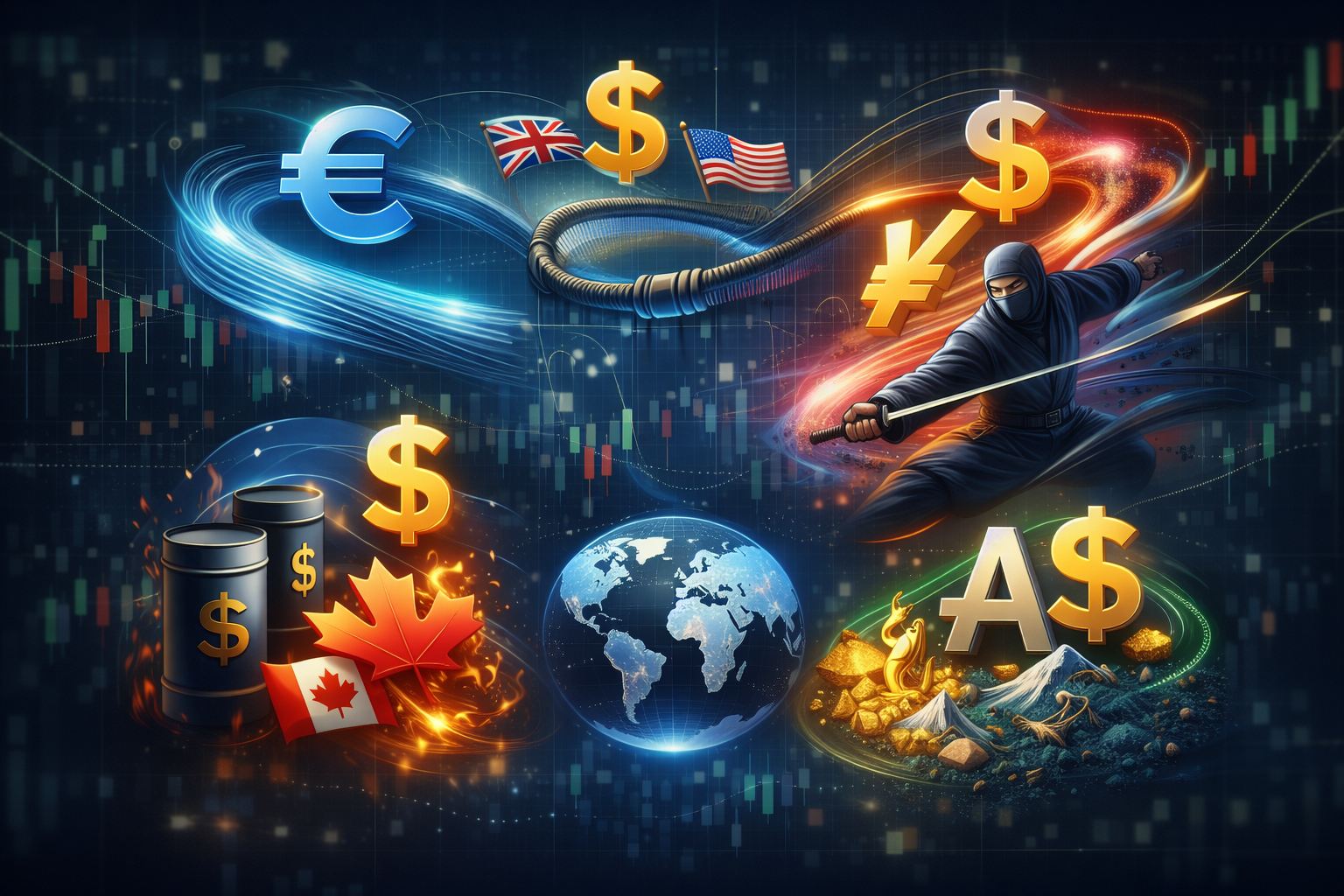
What Are Currency Pair Nicknames?
Forex traders often use nicknames to refer to currency pairs. These names help traders communicate faster and more clearly.
Most nicknames come from:
- Currency symbols
- Country characteristics
- Historical or cultural references
As a result, traders can discuss markets efficiently.
Major Currency Pair Nicknames
Major currency pairs include the US dollar and trade with high liquidity. Because of this, they attract the most attention from traders worldwide.
EUR/USD – The Fiber
EUR/USD is the most traded Forex pair. Traders often call it “The Fiber.”
This nickname reflects the euro’s stability and importance. Both the Eurozone and the United States dominate global finance.
Therefore, this pair strongly influences the Forex market.
GBP/USD – The Cable
GBP/USD carries the nickname “The Cable.” This name has historical roots.
In the past, traders transmitted prices through transatlantic telegraph cables. These cables connected London and New York.
As a result, traders began calling the pair “Cable.”
AUD/USD – The Aussie
AUD/USD is widely known as “The Aussie.” The nickname comes from everyday Australian slang.
This pair closely follows Australia’s economy. Moreover, it often reacts to commodity prices like gold.
Because of this, traders call it a commodity-linked pair.
USD/JPY – The Gopher
USD/JPY is sometimes called “The Gopher.” Traders associate this nickname with quick price movements.
The Japanese yen often moves rapidly during risk shifts. Therefore, this pair attracts both traders and investors.
Its liquidity and volatility make it popular worldwide.
USD/CHF – The Swissie
USD/CHF is known as “The Swissie.” The nickname comes from the word “Swiss.”
Both the Swiss franc and US dollar act as safe-haven currencies. As a result, traders favor this pair during market uncertainty.
Cross Currency Pair Nicknames
Cross currency pairs do not include the US dollar. Instead, they combine two other major currencies.
Because of this, they often show different market behavior.
EUR/GBP – The Chunnel
EUR/GBP is commonly called “The Chunnel.” This nickname refers to the English Channel.
The Channel separates the UK and mainland Europe. Therefore, traders use this name as a geographic reference.
GBP/JPY – The Guppy
GBP/JPY carries the nickname “The Guppy.” The name comes from merging GBP and JPY.
This pair often shows strong volatility. As a result, experienced traders trade it actively.
CHF/JPY – The Swissy
CHF/JPY is sometimes called “The Swissy.” Both currencies serve as safe havens.
Because of this, the pair reacts strongly during global stress. Traders often watch it during uncertain market conditions.
AUD/JPY – The Aussie Yen
AUD/JPY is known as “The Aussie Yen.” The nickname combines both currency identities.
This pair reflects risk sentiment clearly. Therefore, traders use it to gauge market confidence.
Exotic Currency Pair Nicknames
Exotic currency pairs include emerging market currencies. They usually have lower liquidity and higher volatility.
As a result, they carry higher risk.
USD/MXN – The Trump Trade
USD/MXN has no traditional nickname. However, traders began calling it “The Trump Trade” after 2016.
During that period, US–Mexico trade policy uncertainty increased volatility. As a result, the Mexican peso reacted strongly to political news.
This nickname reflects that historical market behavior.
EUR/PLN – The Zloty
EUR/PLN connects the euro with Poland’s currency. Traders often call it “The Zloty.”
The name has historical roots in Polish gold coins. Because of this, the pair attracts yield-focused traders.
USD/ZAR – The Rand
USD/ZAR is known as “The Rand.” The name comes from South Africa’s currency.
“Rand” originates from Witwatersrand, a gold-rich region. As a result, this pair often reacts to commodity trends.
Final Thoughts
Currency pair nicknames simplify trader communication. They also reflect history, culture, and market behavior.
By learning these names, traders understand the market faster. As a result, analysis becomes clearer and more efficient.


One thought on “Currency Pair Nicknames”